The Chronic Economy is the $100B Market Hiding in Plain Sight with Michelle Irving
April 11, 2026
What if the way you’ve been forced to work because of your chronic illness… is actually the way everyone will work in the future?
It’s a question that stopped me in my tracks.
Because for so long, many of us have felt like we were working against the system. Adjusting. Accommodating. Figuring it out as we go.
But what if we’re not behind?
What if we’re just early?
Here’s the truth: the way people with chronic illness work, strategically, intentionally, and energy-first, is not a limitation. It’s a preview of where work is heading.
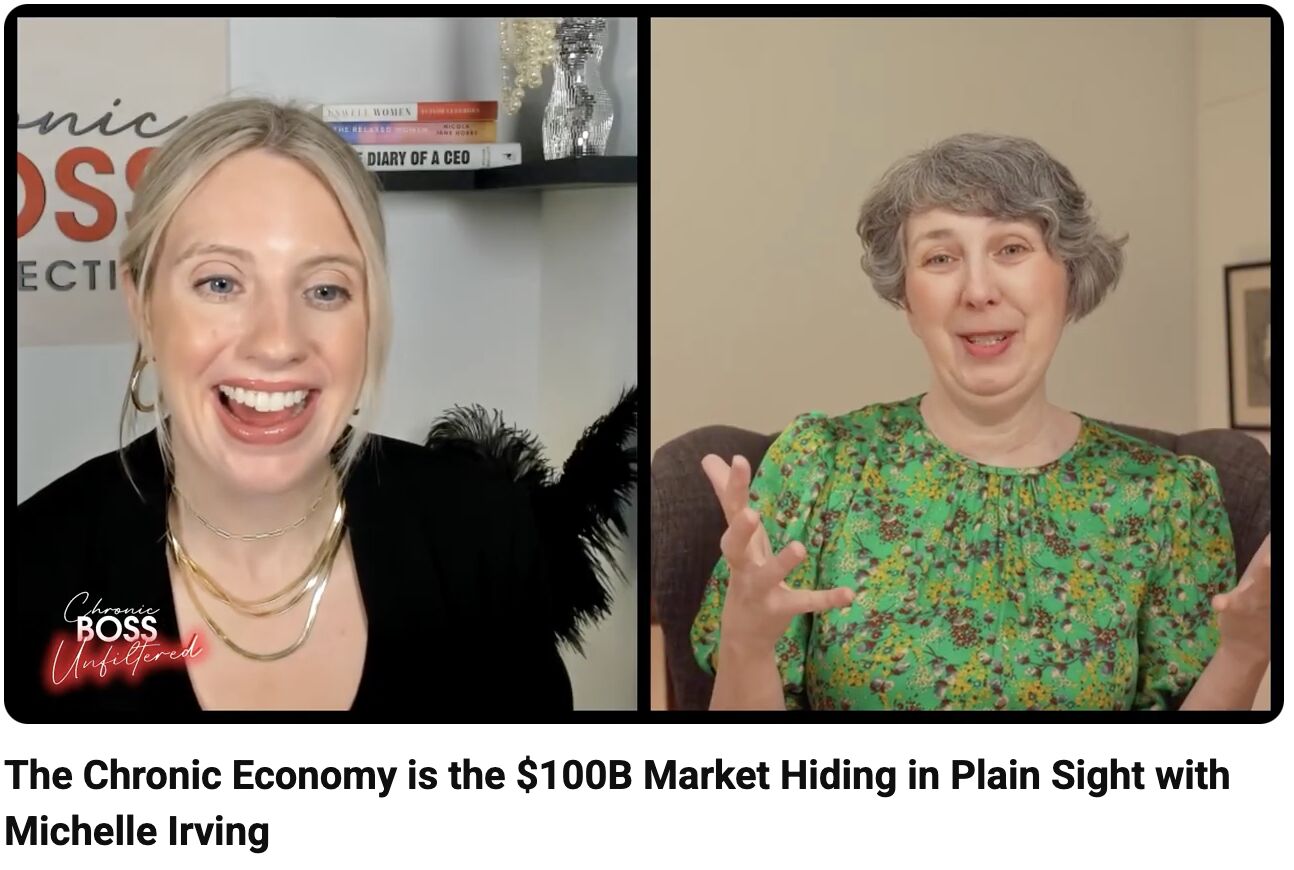
In a recent episode of Chronic Boss Unfiltered, Lilly Stairs sits down with Michelle Irving to unpack this exact idea through the lens of something called the chronic economy.
And once you see it, you can’t unsee it.
What is the “chronic economy” and why does it matter?
The chronic economy is a shift toward working in ways that prioritize energy, outcomes, and sustainability over hours, visibility, and burnout.
This is not a niche conversation.
A significant portion of the workforce is already living with chronic conditions. These are women who are:
- Leading teams
- Building businesses
- Driving innovation
- Navigating unpredictable health at the same time
The issue has never been capability.
It has always been that most workplaces were not designed with this reality in mind.
Are people with chronic illness actually more productive?
In many cases, yes. Just not in the way traditional workplaces measure it.
There is a long-standing assumption that chronic illness equals inconsistency or underperformance.
But if you’ve lived this, you know the truth looks very different.
You’ve likely learned how to:
- Deliver high-impact work in limited windows of energy
- Plan ahead for disruptions before they happen
- Build systems that keep things moving even when you can’t
- Make decisions quickly about what actually matters
That is not underperformance.
That is strategic, intentional productivity.
Productivity is not about how many hours you work. It is about how effectively you use the energy you have.
Why is the traditional work model breaking down?
Because it was built on assumptions that no longer hold up.
The traditional model assumes:
- Energy is consistent
- More hours equal more output
- Being visible means being valuable
But we are watching that model crack in real time.
Burnout is everywhere. Engagement is dropping. More people are questioning whether this is just how work has to be.
For those of us with chronic illness, we already know the answer.
It doesn’t.
What does energy-based work actually look like?
It looks like working with your capacity instead of constantly fighting against it.
Living with a chronic condition forces you to understand your energy in a way most people never have to think about.
You learn:
- When you do your best work
- What drains you versus what drives results
- How to prioritize impact over busywork
And that naturally leads to a different way of working:
- Focusing on outcomes instead of hours
- Structuring your day around energy peaks
- Cutting unnecessary tasks without guilt
- Building flexibility into how you operate
This is not about doing less.
It is about doing what actually matters.
Are boundaries really necessary for success?
Yes. And more than that, they are a strategy.
For many of us, boundaries were not optional. They were survival.
But over time, they become something much more powerful.
They become the foundation of sustainable success.
Strong boundaries look like:
- Clear expectations around your availability
- Thoughtful workload design
- Systems that do not rely on constant output
- The ability to say no without over-explaining
Without boundaries, success is fragile.
With them, it becomes sustainable and scalable.
How do you design a career that works with your health?
You design it intentionally.
Women living with chronic illness are already doing this every day, whether they realize it or not.
That often looks like:
- Building flexibility into your schedule
- Creating systems that support consistency during flares
- Redefining what ambition looks like for you
- Prioritizing your health without stepping away from your goals
This is not about lowering your standards.
It is about raising the standard for what success should look like in the first place.
Why is this the future of work?
Because the skills required to manage chronic illness are becoming the most valuable skills in the workforce.
As work evolves, especially with the rise of automation and AI, the emphasis is shifting toward:
- Strategic thinking
- Decision-making
- Creativity
- Energy and attention management
If you are living with a chronic condition, you are already practicing these daily.
So the question is no longer:
How do you adapt to work?
It becomes:
How does work evolve to match how you already operate?
So what does ambition look like now?
It looks different. And honestly, it looks better.
The old definition of ambition was rooted in:
- Hustle
- Constant availability
- Output at all costs
A more sustainable version of ambition includes:
- Self-awareness
- Intentional growth
- Long-term thinking
- Health as a non-negotiable
For women with chronic illness, this is not aspirational.
It is necessary.
And it works.
FAQ
What is the chronic economy?
The chronic economy refers to a shift toward working in ways that prioritize energy, flexibility, and outcomes. It reflects how many people with chronic illness already operate in their careers.
Can chronic illness make you better at work?
It can. Many people develop strong skills in prioritization, adaptability, and strategic thinking, which are highly valuable in modern workplaces.
How do I manage my energy at work with a chronic illness?
Start by identifying when you have the most energy, prioritizing high-impact tasks during that time, and building in recovery and flexibility where possible.
Is it okay to set boundaries at work because of my health?
Yes. Boundaries are essential for long-term success and help protect both your health and your ability to perform at a high level.
Can I still be ambitious with a chronic illness?
Absolutely. Ambition does not go away. It becomes more intentional, focused, and sustainable.
Final Thoughts
If you have ever felt like you are working twice as hard just to keep up…
If you have questioned whether your pace or your needs make you less capable…
Let this be your reframe.
You are not behind.
You are operating with a level of awareness and intentionality that the rest of the workforce is just starting to understand.
You are not adapting to a broken system.
You are building a better one.
Connect with Michelle Irving
Websites: https://www.chronicillnessatwork.com/
http://careerandchronicillness.com/
LinkedIn – @michelleirvingofficial ( / michelleirvingofficial )
Instagram: @michelleirvingofficial ( / michelleirvingofficial )