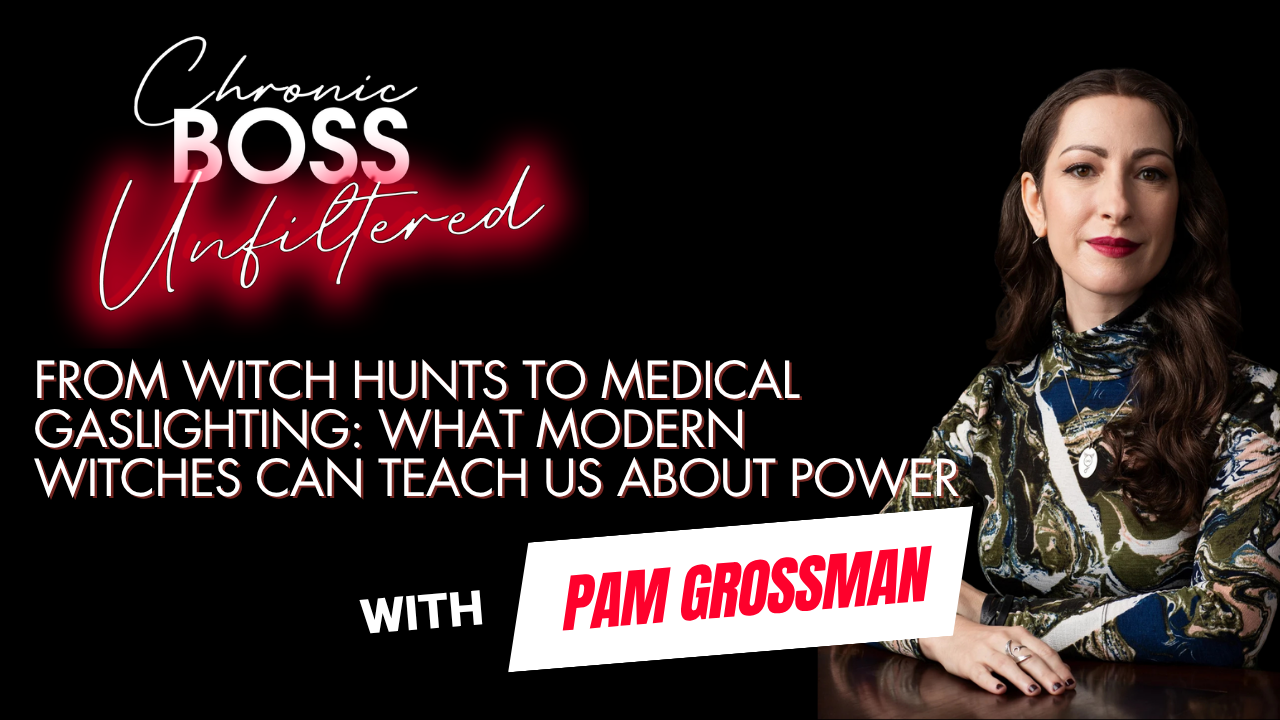
From Witch Hunts to Medical Gaslighting: What Modern Witches Can Teach Us About Power | Pam Grossman
November 8, 2026
Lilly was sent home from the ER three times in one weekend. Each visit, someone asked her some version of the same thing: was she happy at home, was she happy at school. On the third visit they admitted her and found bleeding ulcers in her small intestine. If you’re building a business with Crohn’s, lupus, endometriosis, or any condition that took years and a stack of specialists to name, you have your own version of that weekend, and you know the specific exhaustion of having to prove you’re sick before anyone will help.
That’s the thread Lilly pulled on with Pam Grossman on Chronic Boss Unfiltered. Pam is the author of Waking the Witch and Magic Maker: The Enchanted Path to Creativity, the host of The Witch Wave podcast, and a practicing pagan who was raised Jewish and still claims both. (This fall she led a blessing ritual for the cast and crew of The Rocky Horror Show at Studio 54, so yes, she brings the theater to everything.) What came out of their conversation is a line running from the witch trials straight into the exam room, and a practice you can use at your desk tomorrow.
The women they called witches
Pam started by widening the lens. The witch trials ran roughly from the 15th to the 17th century, mostly across Western Europe, where tens of thousands of people were persecuted. Salem came later and was small by comparison.
Some of the accused were midwives, herbalists, and healers, women whose knowledge of the body made them a threat to the men turning medicine into a profession. Plenty of others were simply inconvenient. They were poor, or older than 40, or widowed with land someone else wanted, or holding a piece of power like a house in their own name. Pam doubts many of them would have called themselves witches at all.
She pointed listeners to Silvia Federici’s Caliban and the Witch, which traces what happened when medicine became something people could profit from. Women who managed their own fertility and their own health with the help of other women were operating outside that market, and that made them dangerous. Health and wealth have been tangled together for a very long time, and the people who held the knowledge were pushed out the moment it could be sold.
Same pattern, new exam room
Lilly said it plainly: she has not met a woman with a chronic condition who doesn’t have a story about being told it’s all in her head. Pam traced that back to who holds the power. When one type of person decides what counts as normal, every body that doesn’t match gets treated as a mystery or a malfunction.
She’s seeing it herself at 45. Entering perimenopause, she asked her doctor how to transition off birth control and got something close to a shrug. Half the population will go through it, and the research is still thin. Lilly added the autoimmune picture: 80% of people living with autoimmune diseases are women, and a federal office for autoimmune disease research only opened a few years ago.
So the old pattern keeps running. It decides whose knowledge counts and whose pain gets funded. AND the women in our community are the ones building around it. Lilly mentioned a founder who just launched a primary care startup designed specifically for people with chronic conditions, because a 10-minute appointment was never built for a body like ours.
What the word means now
Pam uses “witch” two ways. In the literal sense, she casts spells, keeps altars, and follows the pagan wheel of the year. (They recorded heading into Samhain, the season for honoring ancestors.) In the figurative sense, the word stands counter to the patriarchy. It carries respect for feminine power, a belief that you can use your power to change things, and agency without waiting for anyone’s permission. Some people live that through spellwork. Others live it through activism, art, or the business they’re building.
Pam was careful here and said she didn’t want to speak for an experience she hasn’t lived. What she offered was a different model of power, one where being different is welcome and even sacred. Traditional witchcraft makes magic from what’s growing in the backyard and what’s already in the pantry. If your capacity shifts week to week and you’ve learned to build with what you have on a given Tuesday, you already know that operating principle.
Poison into medicine
Pam’s sister, who is Jewish and Buddhist (a “JuBu,” in Pam’s words), built a career in mental health out of her own lived experience. She taught Pam a Buddhist phrase about turning poison into medicine, and Pam hears alchemy in it: rough base materials refined into gold.
Witchcraft makes room for the hard seasons too. “Darkness is not evil,” Pam told Lilly, and in her practice, grief, anger, and loss are part of the ritual rather than things to hide. Lilly connected that to her own story. The stretch she wouldn’t wish on anyone is the reason she has the career she has now, and the reason she notices, every morning, that she can move her joints.
Magician mode
The heart of Magic Maker is Pam’s argument that creativity and magic are the same thing. She grew up loving the surrealist painters Remedios Varo and Leonora Carrington, then learned years later that both had witchcraft practices of their own. David Bowie, she pointed out, used software to shuffle his lyrics like a tarot deck and pulled new songs from the results.
Her one practice for getting back into your creative work is a signal ritual, something that tells you (and whatever you believe you’re collaborating with) that you’re shifting into what she calls magician mode. She cast a full magic circle before every writing session for Magic Maker. Her lighter options:
- Light a candle or incense before you sit down to write, paint, or map out your business plan
- Use one specific mug for tea, play one specific song, or pull a tarot card and ask what to keep in mind for the session
- Keep a small altar on a windowsill with a stone or a photo of a creative hero
If that sounds like one more thing on the list, she wants you to go smaller. One intentional breath counts, “no matter what your limitations might be.” It isn’t a shortcut either. “You still have to do the labor of showing up and sitting down and doing the work,” she said. When people ask whether she’s contacting the spirit world or running a placebo, her answer is simple: “I do not care because I know that it is subjective and it works.”
Creativity is power
Pam closed on why this matters past your own desk. New visions for medicine, business, politics, and family structures all start with someone willing to imagine them, and she named who benefits when we don’t: “There are people who profit off of us being scared, isolated, and stagnant.” Lilly tied it to AI and admitted she catches herself reaching for it faster than she used to, when the push and pull of making something is where the good work comes from.
Pam’s last word on what the witch teaches a chronic boss was this: the witch “wants us to be exactly who we are,” and our specific experiences are gifts meant to be shared. Hear the full conversation on Chronic Boss Unfiltered on Spotify, Apple Podcasts, or YouTube, and then DM us the ritual you use to start your workday. We’d love to see what you light before you build. ✨